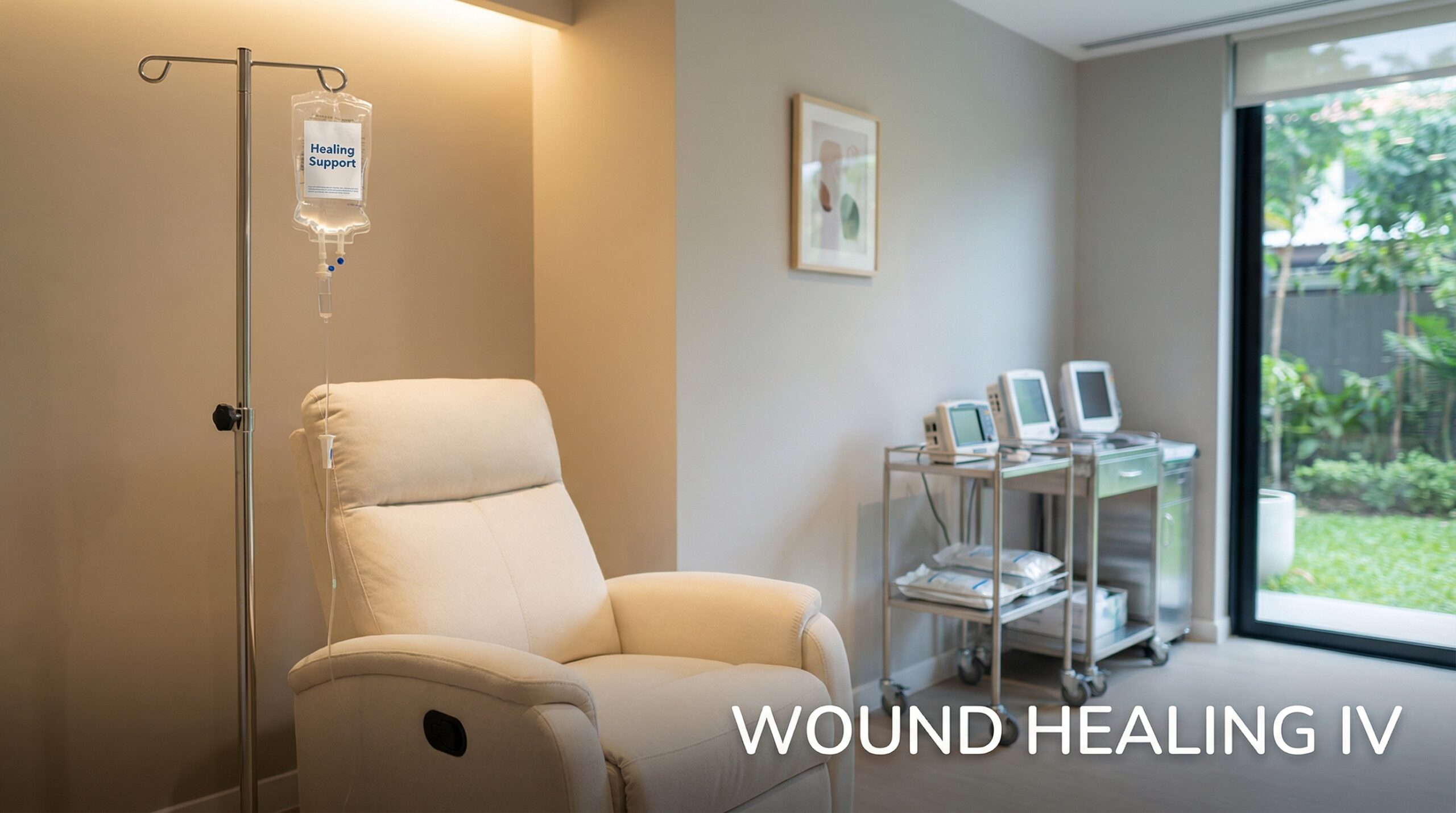
When you are dealing with a surgical incision, chronic ulcer, or slow-healing injury, you naturally focus on what you can see on the surface: dressings, ointments, and follow-up visits. Yet under the skin, wound repair is a highly demanding biological process that depends on oxygen, protein, vitamins, minerals, and a well-regulated immune response. Wound healing IV treatment focuses on delivering these key nutrients directly into the bloodstream to support your body’s own repair systems from the inside out.
This article is for people recovering from surgery, burns, chronic wounds, or injuries who want to understand how IV nutrition may fit into a comprehensive wound care plan. We will walk through how wounds heal, which nutrients matter most, how IV therapy works, and what to discuss with your healthcare team before considering a wound healing IV protocol.
Wound healing IV treatment is an intravenous nutrition approach that delivers fluids, electrolytes, amino acids, vitamins, and minerals directly into a vein to support tissue repair, immune function, and hydration while you heal. It does not replace medical wound care or surgery, but it may help optimize the internal conditions your body needs to rebuild skin and connective tissue, especially when eating enough or absorbing nutrients is difficult.

How does wound healing actually work in the body?
To understand why systemic nutrition and hydration matter, it helps to know the basic phases of wound repair. Normal healing moves through four overlapping stages: hemostasis, inflammation, proliferation, and remodeling. Each step depends on adequate oxygen delivery, protein, micronutrients, and a balanced immune response (“Wound healing and wound management”, Guo & DiPietro, 2010).
The four phases of wound healing
1. Hemostasis begins immediately after injury. Blood vessels constrict, platelets aggregate, and a fibrin clot forms to stop bleeding. This clot also serves as a temporary matrix for incoming cells.
2. Inflammation follows within hours. Neutrophils and macrophages migrate into the wound, clear bacteria and debris, and release signaling molecules called cytokines and growth factors. This phase is essential, but if it is prolonged or excessive, healing can stall (“Wound healing and wound management”, Guo & DiPietro, 2010).
3. Proliferation is when new tissue is built. Fibroblasts produce collagen, endothelial cells form new blood vessels, and keratinocytes migrate to close the surface. This stage is highly energy and protein intensive.
4. Remodeling can last months. Collagen fibers reorganize and strengthen, and the scar gradually becomes flatter and more flexible. Adequate vitamin C, copper, and other cofactors are important for mature collagen crosslinking (“Nutrition and chronic wounds”, Stechmiller, 2010).
Why some wounds become chronic
Chronic wounds such as diabetic foot ulcers, venous leg ulcers, and pressure injuries often get stuck in the inflammatory phase. Factors like poor blood flow, infection, high blood sugar, mechanical stress, and malnutrition disrupt growth factor signaling, new vessel formation, and collagen deposition (“Regenerative and advanced therapies for chronic wounds”, Sorg et al., 2023). Instead of moving forward, the wound cycles through breakdown and partial repair.
In these situations, surface treatments alone are often not enough. Clinicians increasingly use a multimodal strategy that combines local therapies, off-loading, mechanical or energy-based treatments, and systemic optimization including nutrition and, when appropriate, IV support (“Regenerative and advanced therapies for chronic wounds”, Sorg et al., 2023).
What is wound healing IV treatment?
Wound healing IV treatment is a targeted intravenous infusion designed to support tissue repair, immune function, and hydration during the healing process. It typically consists of sterile fluids combined with nutrients that are known to be important for wound repair, delivered directly into a vein by a trained clinician in a controlled setting.
Because IV nutrients bypass the digestive system, they reach the bloodstream quickly and are not limited by gastrointestinal absorption. This can be especially relevant when appetite is low after surgery, when gastrointestinal function is impaired, or when chronic illness affects how well nutrients are absorbed from food (“Nutrition and chronic wounds”, Stechmiller, 2010). IV vitamin therapy may support these systemic needs.
Typical components of a wound healing IV protocol
The exact formula should always be individualized, but many wound healing IV treatment plans may include:
- Balanced IV fluids to support circulation and perfusion of the wound area.
- Electrolytes such as sodium, potassium, magnesium, and calcium to maintain cellular function and nerve and muscle activity.
- Amino acids, the building blocks of protein, which are required for collagen synthesis and new tissue formation. Arginine and glutamine are of particular interest in wound healing research (“Arginine and wound healing”, Barbul, 2006).
- Vitamin C to support collagen crosslinking, antioxidant protection, and immune function (“Nutrition and chronic wounds”, Stechmiller, 2010).
- B-complex vitamins, especially B6, B9 (folate), and B12, which are involved in cell division, red blood cell production, and energy metabolism.
- Zinc, a cofactor in DNA synthesis, cell proliferation, and immune function; deficiency is associated with delayed wound healing (“Nutrition and chronic wounds”, Stechmiller, 2010).
- Copper and other trace minerals that assist in collagen maturation and angiogenesis.
- Antioxidants such as glutathione or vitamin C to help buffer oxidative stress around the wound environment, when used appropriately.
Specific ingredients, doses, and combinations should be determined by a qualified provider who reviews your medical history, medications, and lab values.
How can IV therapy support wound healing?
IV therapy does not close a wound on its own, but it can help create a more favorable internal environment for repair. Several mechanisms are relevant when we think about wound healing IV treatment as part of a broader plan.
1. Supporting collagen synthesis and new tissue growth
Protein and amino acid needs increase significantly during wound healing. Estimates suggest that patients with large or chronic wounds may require 1.25 to 1.5 grams of protein per kilogram of body weight per day to support tissue repair (“Nutrition and chronic wounds”, Stechmiller, 2010). When oral intake is poor, IV amino acid support can help bridge this gap under medical supervision.
Arginine, in particular, is involved in collagen deposition and immune function, and several studies have found that arginine-enriched formulas may improve wound strength and healing in certain surgical and critically ill populations (“Arginine and wound healing”, Barbul, 2006). Vitamin C and zinc are also essential cofactors in collagen formation and epithelialization.

2. Optimizing immune response and infection defense
The immune system is central to wound repair. Deficiencies in vitamins A, C, E, B6, B12, folate, zinc, copper, and iron can impair immune cell function and increase susceptibility to infection (“Nutrition and chronic wounds”, Stechmiller, 2010). IV administration of some of these nutrients, when indicated and dosed appropriately, may help normalize levels more quickly than oral supplementation alone, particularly in patients with malabsorption or high metabolic stress.
Antioxidant support is another consideration. The inflammatory phase of healing generates reactive oxygen species. At appropriate levels, these molecules help kill bacteria and signal repair, but in excess they can damage healthy tissue. Vitamin C and other antioxidants may help maintain balance; however, dosing should be individualized, since very high antioxidant doses could theoretically interfere with some aspects of normal inflammation (“Nutrition and chronic wounds”, Stechmiller, 2010). Antioxidant IV treatment may be relevant to discuss with your care team.
3. Maintaining hydration and microcirculation
Good blood flow is essential for bringing oxygen and nutrients to the wound and removing waste products. Dehydration can reduce circulating blood volume and impair tissue perfusion. IV fluids can rapidly restore hydration status and support stable blood pressure and microcirculation, which are foundational for wound repair, especially after surgery, burns, or acute illness (“Wound healing and wound management”, Guo & DiPietro, 2010). Surgery recovery IV therapy may support hydration needs during healing.
4. Complementing advanced local wound therapies
Modern wound care increasingly uses advanced dressings, bioengineered matrices, and staged surgical approaches to accelerate healing and reduce complications. For example, clinical data presented on devices like PermeaDerm, Cohealyx, and RECELL show that structured pathways combining temporary coverage, wound bed preparation, and definitive closure can shorten hospital stays and improve outcomes in complex burns and trauma (AVITA Medical Boswick Symposium abstracts, 2026).
These technologies work at the wound surface and within local tissues. Systemic optimization through nutrition, including IV support when appropriate, can run in parallel by ensuring that the body has the building blocks it needs to respond to these interventions effectively. This integrated, multimodal mindset is increasingly emphasized in reviews of chronic wound management (“Regenerative and advanced therapies for chronic wounds”, Sorg et al., 2023).
Who might consider wound healing IV treatment?
IV therapy is not necessary for every cut or minor surgical incision. It is most relevant when wounds are larger, healing is slow, or systemic factors limit nutrient intake or absorption. Potential candidates, always in coordination with a healthcare team, may include:
- People recovering from major surgery with large incisions or reconstructive procedures.
- Patients with chronic wounds such as diabetic foot ulcers, venous leg ulcers, or pressure injuries, especially when oral intake is inadequate.
- Individuals with burns or traumatic injuries requiring significant tissue repair.
- Patients with conditions that impair nutrient absorption or appetite, such as gastrointestinal disease, severe illness, or certain medications.
- Older adults with documented micronutrient deficiencies and delayed wound healing.
Before starting wound healing IV treatment, it is important to review the full picture: wound type and severity, underlying diagnoses, medications, kidney and liver function, and current lab values. IV therapy should be one component of a coordinated plan that also addresses blood sugar control, pressure off-loading, smoking cessation, and evidence-based local wound care (“Regenerative and advanced therapies for chronic wounds”, Sorg et al., 2023).
What happens during a wound healing IV session?
While protocols vary by clinic, a typical wound healing IV treatment experience follows a consistent structure focused on safety and comfort.
1. Assessment and customization
Before your first session, you should expect a detailed intake that covers your medical history, medications, allergies, wound type, recent labs, and goals. This information helps determine whether IV therapy is appropriate and which nutrients and doses make sense for you. In some cases, your provider may request additional lab work to assess kidney function, electrolyte balance, or specific micronutrient levels.
2. IV placement and infusion
A trained nurse or clinician will place a small IV catheter, usually in a vein in your arm or hand, after cleaning the skin. The customized IV solution is then connected and allowed to infuse by gravity or pump over 30 to 90 minutes, depending on the formula and your circulation status. You can typically sit back and relax during the session, and your vital signs and comfort level are monitored.
3. Frequency and duration
The ideal schedule depends on your wound, overall health, and treatment goals. Some people may benefit from more frequent sessions in the early intensive phase of healing, then taper to less frequent maintenance as the wound closes. Others may only need a short series of treatments around surgery or during a period of poor oral intake. A personalized plan should be reviewed regularly and adjusted based on your response and any new lab or clinical information.
Evidence, limits, and safety considerations
Research clearly supports the importance of adequate protein and micronutrients for wound healing, and clinical nutrition guidelines endorse aggressive nutrition support for patients with large or chronic wounds (“Nutrition and chronic wounds”, Stechmiller, 2010). Most of this evidence comes from studies of oral supplements or enteral and parenteral nutrition in hospital settings, rather than from standardized wellness IV protocols.
Emerging wound care literature also emphasizes that no single therapy, whether topical, systemic, or mechanical, is sufficient for all wounds. Instead, the best outcomes come from multimodal, personalized combinations that address circulation, infection, mechanical stress, and systemic health together (“Regenerative and advanced therapies for chronic wounds”, Sorg et al., 2023). Safe IV treatment practices are essential for anyone exploring systemic support.
Potential risks and side effects
Although IV therapy is widely used in medical settings, it is not risk-free. Potential side effects can include:
- Bruising, discomfort, or phlebitis (vein irritation) at the IV site.
- Infection at the insertion site if proper sterile technique is not used.
- Fluid overload in people with heart, kidney, or liver disease.
- Electrolyte imbalances if solutions are not properly tailored and monitored.
- Allergic or sensitivity reactions to specific nutrients or additives.
To minimize risk, wound healing IV treatment should be administered by trained professionals, using medical-grade supplies, with appropriate screening, monitoring, and emergency protocols in place. Always inform your providers about all medications, supplements, and medical conditions before starting IV therapy.
How to integrate wound healing IV treatment into your care plan
If you are considering IV support while your wound heals, the goal is to integrate it thoughtfully into a broader, evidence-based strategy rather than viewing it as a stand-alone fix.
Step 1: Start with a medical evaluation
Discuss your interest in IV therapy with your primary care provider, surgeon, or wound specialist. Ask whether there are any contraindications based on your heart, kidney, or liver function, and whether recent labs suggest specific deficiencies that should be addressed.
Step 2: Clarify your wound healing priorities
Work with your care team to define what success looks like: faster closure, fewer dressing changes, less pain, or better long-term scar quality. This can help guide the intensity and duration of any systemic support, including nutrition, physical therapies, and IV treatments.
Step 3: Optimize the foundations
Even the best IV formula cannot compensate for uncontrolled diabetes, ongoing smoking, or constant pressure on a wound. Addressing blood sugar control, smoking cessation, off-loading or compression when indicated, and infection management remains essential. Mechanical and energy-based therapies such as negative pressure wound therapy, shock wave therapy, or ultrasound may also be part of your plan when recommended (“Regenerative and advanced therapies for chronic wounds”, Sorg et al., 2023).
Step 4: Use IV therapy as a targeted adjunct
Once the basics are in place, IV therapy can be layered in as a targeted adjunct to support hydration, nutrient status, and recovery. A personalized protocol, monitored over time, allows your team to adjust components based on clinical progress and any changes in labs or symptoms.
FAQ
How quickly can wound healing IV treatment make a difference?
Response times vary. Some people notice improved energy or hydration after the first few sessions, while measurable changes in wound size or tissue quality typically occur over weeks. IV therapy supports the conditions for healing but does not replace the time your body needs to rebuild tissue.
Is wound healing IV treatment a replacement for proper wound dressings?
No. IV therapy is systemic support. You still need appropriate local wound care, which may include debridement, advanced dressings, off-loading, compression, or surgical procedures, depending on the type of wound.
Can I use wound healing IV treatment if I have diabetes?
Many people with diabetes can receive IV therapy, but it requires careful coordination with your healthcare team. Blood sugar control is critical for wound healing, and some IV formulas may need to be adjusted to avoid affecting glucose levels.
How many IV sessions will I need for wound healing?
The number of sessions depends on wound size, complexity, your baseline nutrition status, and overall health. Some individuals may benefit from a short series around surgery, while others with chronic wounds may use IV support over a longer period, with frequency adjusted as healing progresses.
Are there people who should avoid wound healing IV treatment?
Yes. People with uncontrolled heart failure, severe kidney disease, certain electrolyte imbalances, or a history of severe reactions to IV infusions may not be good candidates. A thorough medical evaluation is essential before starting any IV protocol.
This blog post is intended for informational purposes only and should not be considered medical advice. Always consult a healthcare professional before making changes to your health routine.
Leave a Reply