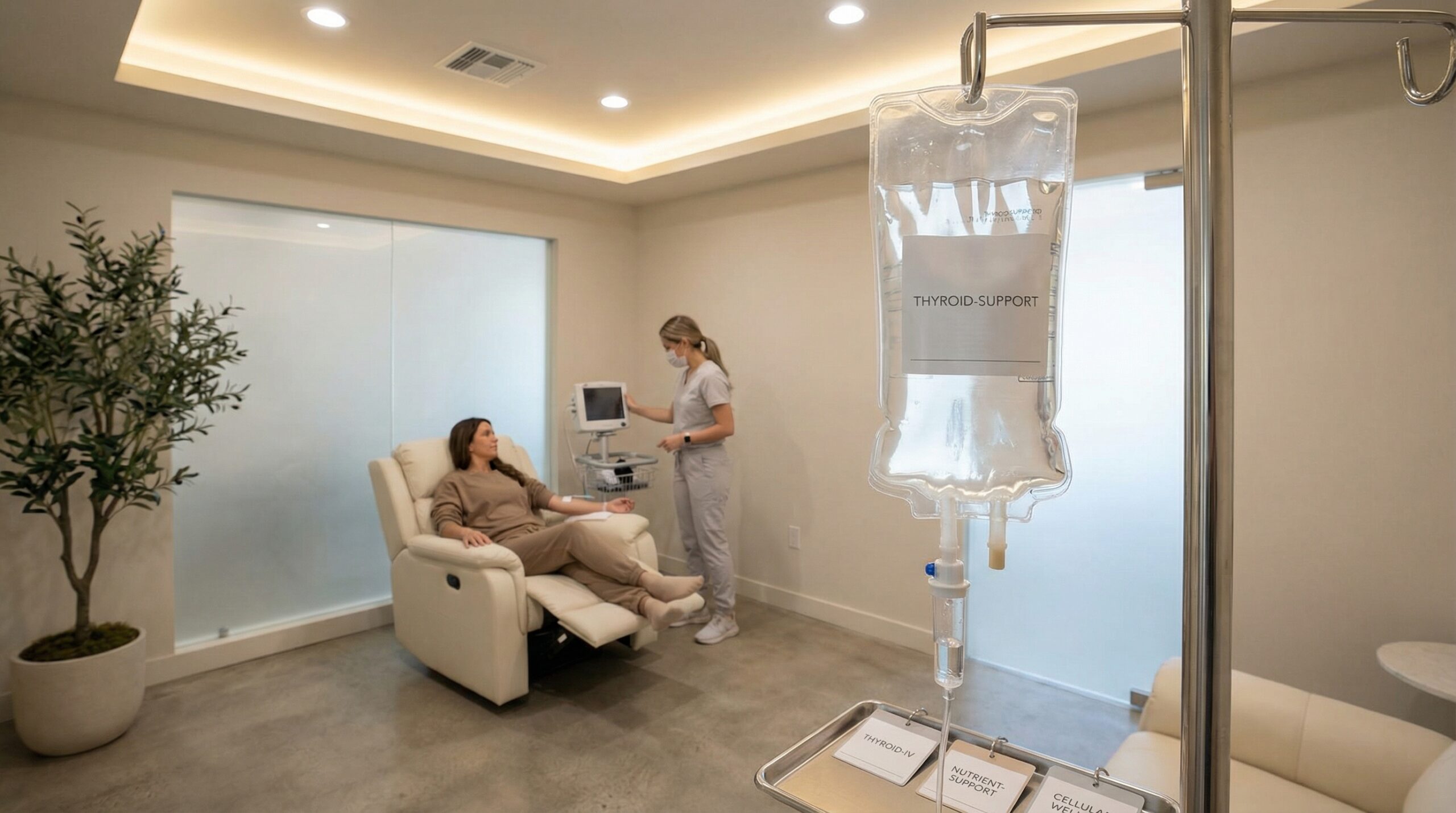
Thyroid issues can leave you feeling exhausted, foggy, and unlike yourself, even when your lab numbers look normal. Thyroid support IV treatment focuses on replenishing key nutrients and hydration directly into your bloodstream to support healthy thyroid hormone production, conversion, and cellular energy. This guide explains how thyroid-focused IV therapy works, what nutrients are typically used, who it may help, and how it can fit alongside your existing thyroid care.
Thyroid support IV treatment is an intravenous vitamin and mineral infusion designed to optimize the nutrients your thyroid and cells rely on, such as selenium, zinc, B vitamins, vitamin D, magnesium, and antioxidants. It does not replace thyroid medication, but it may help support energy, metabolism, and mood by correcting nutrient gaps, improving hydration, and reducing oxidative stress, especially in people with absorption issues or autoimmune thyroid conditions (Selenium and the thyroid, Schomburg, 2016).
What is thyroid support IV treatment?
Thyroid support IV treatment is a customized IV drip that delivers thyroid-relevant nutrients directly into your vein, where they enter your bloodstream at nearly full bioavailability. Unlike a hospital IV that is focused only on acute illness or dehydration, wellness-focused IVs are formulated to support long-term health goals such as better energy, metabolism, and mental clarity.

In a thyroid-focused protocol, a provider may combine hydration, electrolytes, and nutrients that influence thyroid hormone production, conversion of T4 to T3, antioxidant protection of the thyroid gland, and mitochondrial function. This approach aligns with the broader shift in 2025–2026 toward personalized IV nutrient therapy, where drips are tailored to individual lab work, symptoms, and goals rather than one-size-fits-all formulas (personalized IV nutrient therapy).
How does IV therapy support thyroid health?
Your thyroid does not work in isolation. It is part of a larger hypothalamic pituitary thyroid (HPT) axis and interacts with the brain, immune system, gut, and adrenal hormones. Chronic stress, autoimmunity, poor sleep, and micronutrient deficiencies can all impair thyroid function or how your body responds to thyroid hormone (Thyroid hormone and metabolism, Mullur, 2014).
IV therapy supports this system by:
- Rapidly repleting key micronutrients that are required for thyroid hormone synthesis and conversion.
- Bypassing the gut, which can be helpful if you have digestive issues, celiac disease, inflammatory bowel disease, or suspected malabsorption.
- Improving cellular hydration, which supports circulation, nutrient delivery, and detoxification.
- Reducing oxidative stress with antioxidants that help protect thyroid tissue and immune balance.
Research suggests that people with hypothyroidism remain at higher risk for dementia and premature mortality even when TSH is normalized with standard T4 medication alone (Hypothyroidism, dementia and mortality, Bianco, 2025). This has fueled interest in more comprehensive, personalized thyroid care that considers nutrients, inflammation, and overall metabolic health, not just one lab value.
Key nutrients often included in thyroid support IV treatment
Exact formulas vary by provider and are always individualized, but several nutrients show up frequently in thyroid-oriented IV drips because of their roles in hormone metabolism and cellular energy.
Selenium: critical for thyroid hormone conversion and protection
Selenium is one of the most studied micronutrients for thyroid health. Selenoproteins are involved in converting T4 into the active hormone T3 and in antioxidant enzymes that protect the thyroid from oxidative damage (Selenium and the thyroid, Schomburg, 2016). Several clinical trials suggest that selenium supplementation may reduce thyroid peroxidase antibody levels in Hashimoto’s thyroiditis, although results are mixed and not all patients respond (Selenium and autoimmune thyroiditis, Winther, 2015).
In an IV setting, selenium can be delivered directly into the bloodstream as part of a broader antioxidant and micronutrient blend. This may be especially relevant if oral selenium is poorly tolerated or if there are concerns about absorption.
Zinc: supporting hormone synthesis and immune balance
Zinc is required for the synthesis of thyroid-releasing hormone (TRH) and thyroid-stimulating hormone (TSH), as well as for immune regulation. Low zinc status has been associated with hypothyroid symptoms such as hair loss and impaired wound healing (Zinc and thyroid function, Baltaci, 2013). IV zinc, used judiciously, may help correct deficiencies more quickly than oral supplements.
B-complex vitamins: energy, mood, and homocysteine metabolism
B vitamins, especially B12, B6, and folate, are central to energy production, red blood cell formation, and neurotransmitter synthesis. People with autoimmune thyroid disease often have coexisting B12 deficiency or pernicious anemia (Vitamin B12 deficiency and autoimmune thyroid disease, O’Leary, 2015). IV B-complex can support:
- Energy and reduced fatigue
- Mood and cognitive function
- Healthy homocysteine levels, which relate to cardiovascular and brain health
Vitamin D: immune modulation and thyroid autoimmunity
Vitamin D receptors are present in many immune cells, and low vitamin D status has been linked to a higher prevalence of Hashimoto’s thyroiditis and Graves’ disease in observational studies (Vitamin D and autoimmune thyroid diseases, Kim, 2014). While oral vitamin D is effective for most people, IV vitamin D may be considered in select cases as part of a comprehensive infusion, especially when rapid repletion is needed under medical supervision.
Magnesium: calming the nervous system and aiding conversion
Magnesium participates in hundreds of enzymatic reactions, including those involved in ATP (cellular energy) production and hormone signaling. Low magnesium has been associated with increased inflammation and may worsen symptoms like muscle cramps, anxiety, and poor sleep, which are common in thyroid disorders (Magnesium and chronic disease, Grober, 2017).
Vitamin C, glutathione, and other antioxidants
Oxidative stress is thought to play a role in thyroid autoimmunity and tissue damage (Oxidative stress in autoimmune thyroid disease, Ruggeri, 2014). IV vitamin C and glutathione are often used together to support antioxidant defenses and detoxification pathways. High-dose IV vitamin C has been shown to reach plasma levels that are not achievable with oral dosing and can modulate immune responses (Pharmacologic ascorbic acid concentrations, Padayatty, 2004).
Who might consider thyroid support IV treatment?
Thyroid support IV treatment is not a replacement for medical diagnosis or prescription thyroid medication. However, it may be considered as an adjunctive therapy for several groups under the guidance of a qualified provider:
- People with Hashimoto’s thyroiditis or autoimmune thyroid disease who want to support nutrient status and antioxidant capacity alongside standard care (Hashimoto’s thyroiditis overview, Ragusa, 2022).
- Individuals with persistent fatigue, brain fog, or mood changes despite apparently normal thyroid labs.
- Those with digestive disorders or suspected malabsorption where oral supplements are less effective.
- People with high-demand lifestyles who want structured, data-driven nutrient support as part of a broader wellness plan.
Recent large-scale research suggests that even well-treated hypothyroid patients may carry a higher long-term risk of dementia and mortality, which has prompted a shift toward more personalized thyroid management that goes beyond a single medication and lab number (Hypothyroidism, dementia and mortality, Bianco, 2025).
How does thyroid support IV treatment fit with standard thyroid care?
Standard thyroid care typically includes lab testing and, when indicated, medications such as levothyroxine (T4) or combination T4/T3 therapy. These remain the foundation for correcting hormone deficiencies and are supported by decades of clinical evidence (Hypothyroidism treatment guidelines, Jonklaas, 2014).
Thyroid support IV treatment is best viewed as a complementary tool, not a substitute. It can help address:
- Nutrient gaps that medications alone do not correct.
- Symptoms like fatigue or brain fog that may be influenced by micronutrient status, inflammation, or mitochondrial function.
- Recovery and resilience around more advanced thyroid interventions, such as surgery or minimally invasive procedures.
For example, emerging interventional radiology techniques like pressure-enabled thyroid artery embolization (PED-TAE) are being explored as alternatives or adjuncts to thyroid surgery in selected patients with large goiters or toxic nodules. Early data show substantial volume reduction and symptom relief with a favorable safety profile (Pressure-enabled thyroid artery embolization, McWilliams, 2024). While IV nutrient therapy does not treat nodules directly, it can be part of a broader wellness strategy before and after such procedures, focusing on hydration, antioxidant support, and metabolic health.
What happens during a thyroid support IV session?
Although every clinic has its own process, a typical thyroid-focused IV experience follows a structured pathway.
1. Assessment and personalization
You usually begin with a consultation that may include:
- Review of thyroid labs (TSH, free T4, free T3, antibodies).
- Medical history, medications, and supplements.
- Symptoms such as fatigue, weight changes, mood, sleep, and digestion.
- Discussion of goals, for example more stable energy or support during a stressful period.
Based on this, the provider designs an IV plan that may adjust nutrient doses, frequency, and duration. Personalization is important because both deficiency and excess of certain nutrients, such as selenium, can be harmful (Selenium status and health, Rayman, 2012).

2. The infusion itself
During the session:
- A trained nurse or provider places a small IV catheter, usually in a vein in your arm or hand.
- Your customized nutrient solution is infused over 30–90 minutes, depending on the formula.
- You are typically seated in a comfortable, spa-like environment where you can read, relax, or work quietly.
Because IV therapy bypasses digestion, nutrients enter the bloodstream directly. Studies on IV vitamin C, for instance, show that blood levels achieved are many times higher than those from oral dosing, which may translate to different biological effects (in-office IV treatment).
3. Frequency and ongoing care
There is no one-size-fits-all schedule. Some people use a series of weekly sessions initially to correct deficiencies, then shift to maintenance sessions every few weeks, similar to structured immune-support protocols that build a foundation and then maintain it over time (Micronutrients and immune function, Gombart, 2020).
Your provider may periodically recheck labs, review symptoms, and adjust your IV plan, medications, nutrition, and lifestyle recommendations accordingly.
Benefits and limitations of thyroid support IV treatment
Potential benefits
When appropriately used as part of a comprehensive plan, thyroid support IV treatment may offer:
- Faster nutrient repletion than oral supplements, especially for B12, vitamin C, and certain minerals.
- Improved energy and reduced fatigue by supporting mitochondrial function and red blood cell production.
- Support for mood and cognitive clarity, which are closely linked to thyroid and B-vitamin status (Thyroid disease and cognition, Samuels, 2011).
- Antioxidant and immune modulation, relevant for autoimmune thyroid conditions.
- Enhanced hydration, which can help circulation, blood pressure regulation, and overall vitality.
Important limitations
It is equally important to be clear about what thyroid support IV treatment does not do:
- It does not cure hypothyroidism, Hashimoto’s, or Graves’ disease.
- It does not replace thyroid hormone replacement when this is medically indicated.
- Evidence for IV nutrient therapy is growing but still limited; many benefits are extrapolated from oral nutrient studies and clinical experience rather than large randomized trials.
For these reasons, IV therapy should always be coordinated with your primary care provider or endocrinologist and should be integrated into a broader plan that may include medication, nutrition, sleep optimization, stress management, and, in some cases, advanced interventions like thyroid artery embolization (intravenous therapy).
Are there side effects or risks with thyroid support IV treatment?
Any intravenous therapy carries some risks, even when performed in a wellness setting.
Potential side effects can include:
- Mild discomfort, bruising, or bleeding at the IV site.
- Temporary lightheadedness or changes in blood pressure.
- Allergic or sensitivity reactions to specific nutrients, which can range from mild to serious.
- Fluid overload in people with certain heart, kidney, or liver conditions.
Serious complications such as infection or vein inflammation are uncommon when protocols are followed, but they are possible with any IV access (Complications of peripheral IV catheters, Alexandrou, 2015). This is why screening, medical oversight, sterile technique, and careful monitoring are essential.
Certain nutrients, including selenium and vitamin D, can be toxic at high doses, so IV formulations must be designed and dosed by qualified professionals who understand your full medical history and medication list (Selenium status and health, Rayman, 2012).
How to integrate thyroid support IV treatment into your wellness plan
To get the most from thyroid-focused IV therapy, it should be one piece of a larger, evidence-informed strategy.
1. Start with proper diagnosis
If you suspect thyroid issues, begin with a thorough evaluation that may include TSH, free T4, free T3, thyroid antibodies, and, when indicated, imaging. Untreated thyroid disease can have serious consequences for heart, brain, and metabolic health (Hypothyroidism treatment guidelines, Jonklaas, 2014).
2. Optimize medication first
Work with your prescribing clinician to find the right dose and type of thyroid hormone replacement for you. Some patients do well on T4 alone, while others may benefit from combination therapy, as suggested by emerging research on long-term outcomes (Hypothyroidism, dementia and mortality, Bianco, 2025).
3. Layer in nutrition and lifestyle
Use food, movement, sleep hygiene, and stress management to support your thyroid and immune system. This may include:
- A nutrient-dense diet with adequate protein, healthy fats, and fiber.
- Attention to gut health and possible food triggers if you have autoimmunity (Gut and autoimmune disease, Lerner, 2016).
- Consistent sleep and circadian rhythm support.
4. Use IV therapy strategically
Once the basics are in place, thyroid support IV treatment can be used to:
- Correct documented deficiencies more quickly.
- Support you through high-stress periods, travel, or recovery phases.
- Complement other therapies in a personalized wellness program.
Discuss timing, frequency, and goals with your provider so that each infusion fits into a clear plan rather than being a one-off experience.
Next steps if you are considering thyroid support IV treatment
If you are curious whether thyroid-focused IV therapy might be appropriate for you, the logical next step is a detailed consultation. Bring your most recent labs, a list of medications and supplements, and a clear description of your symptoms and goals. A qualified provider can help you understand where nutrient infusions might add value and where other interventions should come first.
Thyroid support IV treatment works best when it is personalized, medically supervised, and integrated into a broader strategy that respects both the complexity of thyroid physiology and your unique health story.
FAQ
How quickly will I feel a difference from thyroid support IV treatment?
Some people report feeling more hydrated, clear-headed, or energized within hours to days after an infusion, especially if they were significantly depleted. Others notice more gradual changes over several sessions as nutrient levels normalize and lifestyle or medication adjustments take effect. Responses vary and cannot be guaranteed.
Can thyroid support IV treatment replace my thyroid medication?
No. IV nutrient therapy does not replace thyroid hormone when your body is not producing enough. Medications like levothyroxine or combination T4/T3 remain the standard of care for hypothyroidism. IV therapy is best used as a complementary support alongside, not instead of, prescribed treatment.
Is thyroid support IV treatment safe if I have Hashimoto’s thyroiditis?
Thyroid support IV treatment can be used in people with Hashimoto’s when it is carefully designed and monitored by a qualified provider. The focus is usually on gentle nutrient repletion and antioxidant support rather than aggressive dosing. Because autoimmune conditions can be complex, coordination with your endocrinologist or primary care clinician is important.
How often should I get a thyroid support IV?
Frequency depends on your goals, baseline nutrient status, and how you respond. Some people start with weekly sessions for a few weeks, then transition to maintenance infusions every three to four weeks. Others may only need periodic support during high-stress times. A personalized plan based on labs and symptoms is essential.
Are there people who should avoid thyroid support IV treatment?
People with certain heart, kidney, or liver conditions, those who are pregnant, and individuals with a history of severe allergies may not be good candidates for IV therapy or may require significant modifications. A thorough medical screening is necessary to determine whether IV treatment is appropriate and safe for you.
This blog post is intended for informational purposes only and should not be considered medical advice. Always consult a healthcare professional before making changes to your health routine.
Leave a Reply