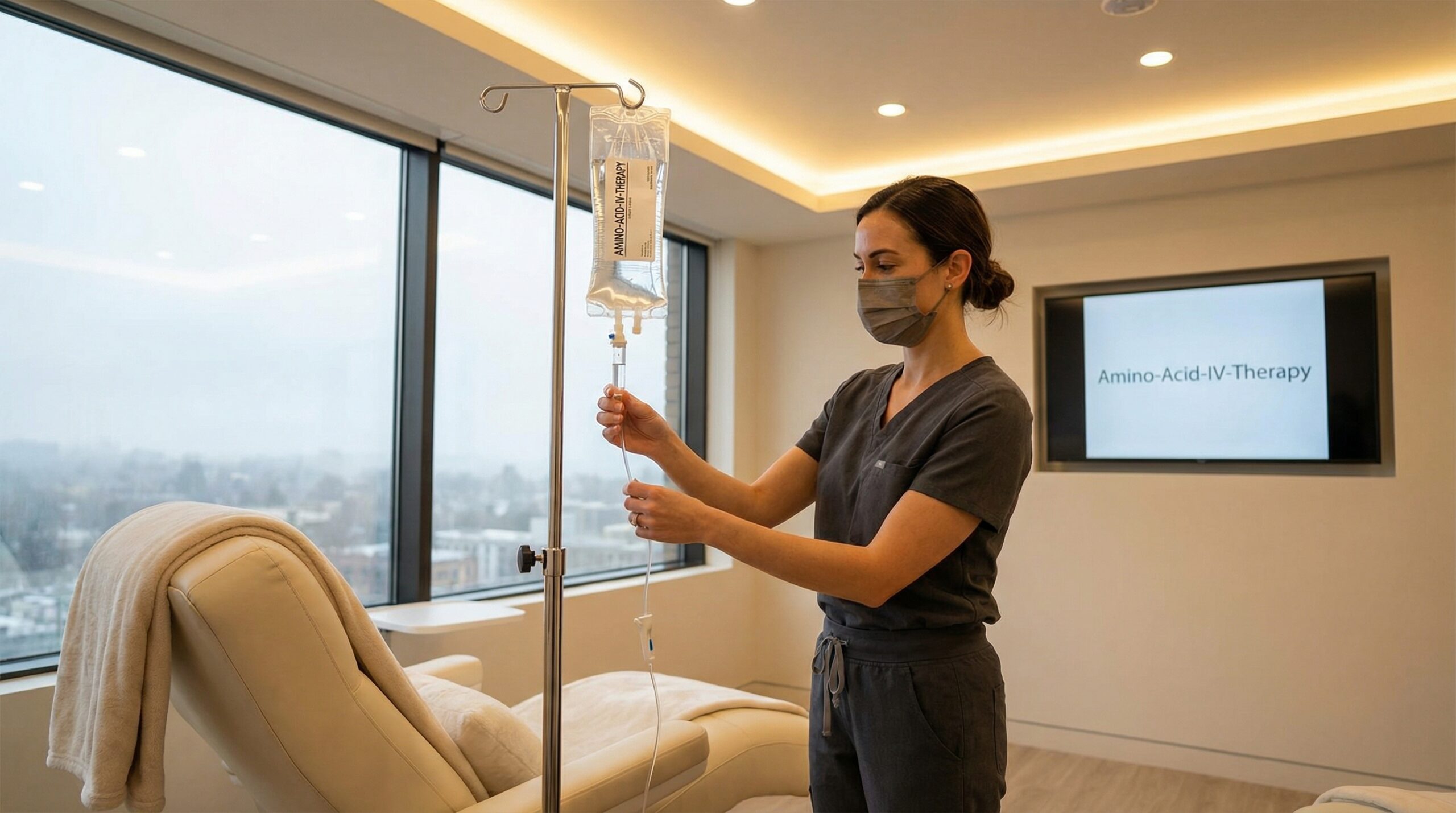
If you are feeling drained, slow to recover from workouts, or like your usual diet and supplements are not quite getting you back to your best, you may have started hearing about amino acid IV therapy. This approach delivers carefully selected amino acids directly into the bloodstream to support energy, muscle recovery, metabolism, and overall wellness, without relying on the digestive system to absorb them.
This guide is for health-conscious adults, active individuals, and busy professionals who want to understand what amino acid IV therapy is, how it works, what the science actually says, and how to decide if it might fit into a broader wellness plan.
Amino acid IV therapy is a treatment where specific amino acids, such as glutamine, arginine, lysine, citrulline, and carnitine, are infused directly into your bloodstream through an intravenous drip. By bypassing digestion, IV delivery can provide rapid, predictable amino acid levels in the blood, which may help support energy production, muscle repair, circulation, immune function, and recovery in people whose needs are higher than what food or oral supplements alone can reliably cover (Intravenous Fluid Therapy, StatPearls, 2023; Amino acid injections: benefits and uses, Olympia Pharmacy, 2022).
What is amino acid IV therapy?
Amino acids are the building blocks of proteins, which your body uses for muscle tissue, enzymes, hormones, neurotransmitters, immune cells, and structural components like collagen. Nine of them are considered essential, meaning you must get them from food, while others are nonessential or conditionally essential, which means your body can usually make them but may fall short during illness, injury, intense training, or chronic stress (Amino Acids: Metabolism and Functions, Wu, 2009).
Amino acid IV therapy is a wellness-focused IV drip that delivers a blend of amino acids directly into a vein. Typical blends used in performance and recovery settings include ingredients such as:
- Glutamine for gut and immune support, and muscle recovery
- Arginine and citrulline for blood flow and nitric oxide production
- Ornithine for detoxification support and urea cycle function
- Lysine for collagen formation, calcium absorption, and immune health
- Carnitine for fat metabolism and mitochondrial energy production
- Sometimes branched-chain amino acids (BCAAs) like leucine, isoleucine, and valine for muscle protein synthesis
Because the nutrients go straight into the bloodstream, IV delivery bypasses the digestive tract and first-pass metabolism in the liver, which can limit how much of an oral supplement is ultimately absorbed (Intravenous Fluid Therapy, StatPearls, 2023). This is the same principle that underlies broader IV nutrient therapy for IV vitamin therapy (IV Vitamin Therapy Overview, Waltzman Institute, 2023).

How does amino acid IV therapy work in the body?
When amino acids enter your bloodstream through an IV drip, they circulate quickly and are taken up by tissues that need them. The potential benefits come less from any single “magic” ingredient and more from how the blend supports several core systems at the same time.
1. Supporting muscle recovery and performance
Exercise, especially resistance and high-intensity training, creates microscopic damage in muscle fibers. Amino acids are required to repair that damage and build new muscle tissue through a process called muscle protein synthesis. Leucine, one of the branched-chain amino acids, is particularly important because it activates the mTOR pathway, which signals the body to increase protein synthesis (Leucine and muscle protein synthesis, Kimball, 2016).
Research suggests that supplemental essential amino acids and BCAAs can reduce markers of muscle damage and soreness and may support faster recovery after strenuous exercise (Branched-chain amino acid supplementation and exercise, Shimomura, 2004). Delivering amino acids intravenously is being explored as a way to rapidly provide these building blocks when demand is high, such as in athletes, post-surgical patients, or people recovering from illness (Amino acid injections: benefits and uses, Olympia Pharmacy, 2022). This may complement a performance enhancement IV plan.
2. Enhancing circulation and blood flow
Several amino acids in common IV blends, including arginine and citrulline, are precursors to nitric oxide, a signaling molecule that relaxes blood vessels and improves blood flow. Clinical research shows that L-arginine and L-citrulline supplementation can increase nitric oxide availability and may improve endothelial function and exercise performance in some populations (L-arginine and L-citrulline in sports nutrition, Bailey, 2014).
By providing these amino acids directly into the bloodstream, amino acid IV therapy may support better circulation, which can help deliver oxygen and nutrients to working muscles and other tissues more efficiently. This is one reason these drips are often marketed for stamina, endurance, and recovery.
3. Supporting energy production and metabolism
Carnitine, often included in amino acid IV formulas, helps shuttle long-chain fatty acids into mitochondria, where they can be burned for energy. Human studies have found that L-carnitine supplementation may reduce muscle soreness, improve recovery, and enhance markers of mitochondrial function and fat metabolism in some individuals (L-carnitine and exercise performance, Fielding, 2018).
Other amino acids, such as lysine and glutamine, participate in protein metabolism and can influence how the body uses protein and carbohydrates for fuel. When combined with B vitamins in comprehensive IV nutrient drips, amino acids may help support more efficient energy production and reduced perception of fatigue (Energy and amino acid-based IV blends, PRINE Energize, 2023).
4. Immune function and gut integrity
Glutamine is a major fuel source for immune cells and the cells lining the gut. During stress, illness, or intense training, glutamine levels can fall, and this has been associated with impaired immune function and increased infection risk (Glutamine and immune function, Newsholme, 2001). Studies in clinical settings have explored glutamine supplementation in patients under metabolic stress and found potential benefits for immune function and gut barrier integrity, although results are mixed and depend on dose and patient population (Glutamine supplementation in critical illness, Wischmeyer, 2014).
By delivering glutamine intravenously as part of an amino acid blend, IV therapy may help support these high-demand tissues, especially in people with increased physiological stress. However, more targeted clinical trials are needed in wellness populations to define optimal protocols.
What are the potential benefits of amino acid IV therapy?
In a wellness or performance setting, amino acid IV therapy is not intended to treat disease. Instead, it is positioned as a tool to support core functions that may already be under strain from modern lifestyles, heavy training, or recovery from illness.

1. Reduced fatigue and more stable energy
Because amino acids are central to both mitochondrial function and neurotransmitter production, optimizing their availability may help some people experience more consistent energy and less burnout. Carnitine helps cells use fat for fuel, while amino acids like tyrosine and phenylalanine are precursors to dopamine and norepinephrine, which influence motivation and alertness (Amino acids and brain function, Fernstrom, 2013). When these nutrients are combined with B vitamins in IV formulations, clients often report feeling more energized within hours, although responses vary widely (IV nutrient therapy for energy, Waltzman Institute, 2023).
2. Faster recovery from workouts and physical stress
Active individuals, athletes, and people with physically demanding jobs may use amino acid IV drips as part of a recovery plan. The goal is to provide the raw materials needed for muscle repair, reduce post-exercise soreness, and support quicker return to training. Evidence from oral amino acid and BCAA studies suggests benefits for reducing muscle damage markers and perceived soreness after intense exercise (Effects of BCAA supplementation on muscle soreness, Jackman, 2010). IV delivery may offer faster uptake, but direct comparison trials between IV and oral routes in healthy wellness clients are limited. This may complement recovery IV therapy.
3. Support for body composition and metabolism
Some amino acids are involved in fat metabolism and lean mass preservation. Carnitine helps transport fatty acids into mitochondria, and lysine participates in carnitine synthesis and collagen formation, which is important for connective tissue (Carnitine and fat metabolism, Flanagan, 2010). Leucine and other essential amino acids help maintain muscle mass during calorie restriction, which is important for keeping metabolic rate stable during weight loss (Leucine and metabolic regulation, Layman, 2003). Amino acid IV therapy is sometimes used alongside nutrition and exercise programs to support these goals, but it is not a standalone weight-loss solution.
4. Skin, hair, and connective tissue support
Amino acids like lysine, proline, and glycine are key components of collagen and keratin, which are structural proteins in skin, hair, and nails. Adequate amino acid availability helps maintain skin elasticity and supports repair from everyday wear and tear (Collagen synthesis and amino acids, Shaw, 2015). Some IV wellness programs pair amino acids with vitamin C and biotin to offer “beauty from within” or radiance-focused drips (IV vitamin therapy and skin health, Waltzman Institute, 2023).
5. Cognitive function, mood, and sleep
Several amino acids serve as precursors to neurotransmitters that influence mood, focus, and sleep. Tryptophan is required to make serotonin and melatonin, tyrosine contributes to dopamine and norepinephrine, and glutamine can be converted to the calming neurotransmitter GABA. Reviews of amino acid therapy in mental health suggest that targeted supplementation may support mood, stress resilience, and sleep quality in some individuals, particularly when deficiencies are present (Amino acid-based treatments in psychiatry, Mischoulon, 2012). Amino acid IV therapy aims to deliver these precursors efficiently, but it should be integrated with, not replace, standard mental health care.
Who might consider amino acid IV therapy?
Most people can meet their amino acid needs through a balanced diet that includes high-quality protein sources. However, certain situations can increase demand or reduce absorption, which is where amino acid IV therapy may be considered as part of a broader plan.
- Highly active individuals and athletes seeking faster recovery between sessions
- People experiencing chronic stress, burnout, or persistent low energy
- Individuals recovering from illness, surgery, or injury, under medical supervision
- Those with digestive issues that may impair nutrient absorption, such as inflammatory bowel disease or certain post-surgical states
- Clients pursuing structured weight-management or body recomposition programs who want to support lean mass and metabolism
In clinical practice, amino acid therapy is often most effective when it is personalized, which can include reviewing health history, diet, medications, and sometimes lab testing to identify specific deficiencies or imbalances (Personalized amino acid treatment framework, Pain and Spine Specialists, 2023).
Is amino acid IV therapy safe?
For most healthy adults, amino acid IV therapy is generally well tolerated when administered by trained professionals using sterile technique and medical-grade ingredients. However, it is not risk-free, and it is not appropriate for everyone.
Potential side effects can include:
- Discomfort, bruising, or inflammation at the IV site
- Temporary flushing, warmth, or taste changes during infusion
- Nausea, headache, or lightheadedness in some individuals
- Very rarely, allergic reactions or vein irritation
People with kidney or liver disease, certain cardiovascular conditions, or specific metabolic disorders may not be good candidates for high-dose amino acid infusions and require careful evaluation (Parenteral nutrition and amino acids, Singer, 2019). It is important to review your full medical history and current medications with a qualified provider before starting therapy.
What to expect during an amino acid IV session
While protocols differ by clinic, a typical amino acid IV therapy visit includes:
- Consultation: A brief review of your health history, goals, medications, and any contraindications.
- Customization: Selection of an amino acid blend that aligns with your priorities, such as energy, recovery, or resilience.
- Placement: A trained professional places a small IV catheter, usually in a vein in your arm or hand.
- Infusion: The amino acid solution drips in over about 30 to 60 minutes, while you sit or recline comfortably.
- Monitoring: Your provider checks on you periodically and can adjust the rate if you feel uncomfortable.
- Post-session: Most people can return to normal activities right away, although staying hydrated and avoiding unusually strenuous activity immediately afterward is often recommended.
How often can you do amino acid IV therapy?
Frequency depends on your goals, health status, and how you respond. Some people schedule a series of weekly or biweekly sessions during times of heavy training or high stress, then move to maintenance visits once or twice a month. Others may use amino acid IV therapy more occasionally, such as before or after major athletic events or during periods of intense workload.
There is no one-size-fits-all schedule supported by strong clinical trials in healthy wellness clients. A personalized plan developed with your provider, ideally integrated with nutrition, sleep, and exercise strategies, is more likely to be effective and sustainable (Personalized IV wellness programs, PRINE IV Therapy, 2023).
How to decide if amino acid IV therapy is right for you
Before trying amino acid IV therapy, it is helpful to clarify your goals and make sure the basics of your health routine are in place.
1. Start with the foundations
No IV drip can replace consistent sleep, whole-food nutrition, regular movement, and stress management. Amino acid IV therapy tends to work best as an adjunct to, not a substitute for, these fundamentals.
2. Clarify your primary goals
Common goals include:
- Improving day-to-day energy and resilience
- Shortening recovery time between workouts or long workdays
- Supporting a structured weight-management or body recomposition plan
- Enhancing skin, hair, and overall vitality from the inside out
Being specific about what you want to feel or change makes it easier for a provider to recommend an appropriate blend and schedule.
3. Discuss your medical history with a qualified provider
Because amino acids influence metabolism, circulation, and neurotransmitters, it is important to review chronic conditions, medications, and supplements with a clinician who understands IV nutrient therapy. They can help you weigh potential benefits against risks, consider lab testing if indicated, and decide whether IV, oral, or a combination approach makes the most sense.
FAQ
How quickly will I feel the effects of amino acid IV therapy?
Some people notice increased energy or a sense of clarity within a few hours of an amino acid IV session, while others experience more subtle changes over several days as their body uses the nutrients. Response depends on your baseline status, the specific blend used, and how well you are supporting yourself with sleep, hydration, and nutrition.
Is amino acid IV therapy better than taking amino acid supplements by mouth?
IV delivery bypasses digestion and first-pass liver metabolism, so it can produce faster and more predictable blood levels of amino acids compared with oral supplements (Intravenous Fluid Therapy, StatPearls, 2023; Amino acid injections: benefits and uses, Olympia Pharmacy, 2022). However, oral amino acids are still effective for many people and are more practical for long-term daily use. The best approach depends on your goals, gut health, and budget.
Can amino acid IV therapy help with weight loss?
Amino acid IV therapy is not a stand-alone weight-loss treatment, but certain amino acids, such as carnitine and leucine, may support fat metabolism and preservation of lean muscle when combined with a structured nutrition and exercise plan (Carnitine and fat metabolism, Flanagan, 2010; Leucine and metabolic regulation, Layman, 2003). Any weight-management strategy should be supervised by a healthcare professional.
How long do the benefits of an amino acid IV drip last?
Many clients report feeling benefits for several days to a couple of weeks, especially in terms of energy and recovery. The duration depends on the blend, your activity level, stress load, and how well you maintain supportive habits. Regular sessions may be recommended during high-demand periods, with spacing adjusted based on how you feel.
Who should avoid or be cautious with amino acid IV therapy?
People with significant kidney or liver disease, uncontrolled cardiovascular conditions, certain metabolic disorders, or a history of reactions to IV infusions should be cautious and only consider amino acid IV therapy under close medical supervision (Parenteral nutrition and amino acids, Singer, 2019). Pregnant or breastfeeding individuals should consult their obstetric provider before any IV nutrient treatment.
This blog post is intended for informational purposes only and should not be considered medical advice. Always consult a healthcare professional before making changes to your health routine.
Leave a Reply